
Commercial General Liability Insurance Policy
Complete Guide to Limits in a Commercial General Liability Insurance Policy


What is a Commercial General Liability Insurance Policy?
A Commercial General Liability Insurance Policy, also known as a CGL Policy, provides coverage to the Insured for Defence Costs and Compensatory Damages that the Insured becomes legally liable to pay on account of the Bodily Injury or Property Damage suffered by a Third Party by a Company’s Operations, Products or Injuries that occur within the Insured Person’s Business Premises. A CGL Policy is a mainstay for any business looking to secure itself against lawsuits alleging Bodily Injury, Property Damage and Personal and Advertising Injury.
What are various limits in a CGL Policy?
A Commercial General Liability Insurance Policy has various limits and it is important to understand as to how the various limits apply and how they impact the Cost of Commercial General Liability Insurance Policy. A Limit in a CGL Policy refers the maximum amount that the Insurance Company will pay in case of an Admissible Claim regardless of the number of Claims Made under the Policy.
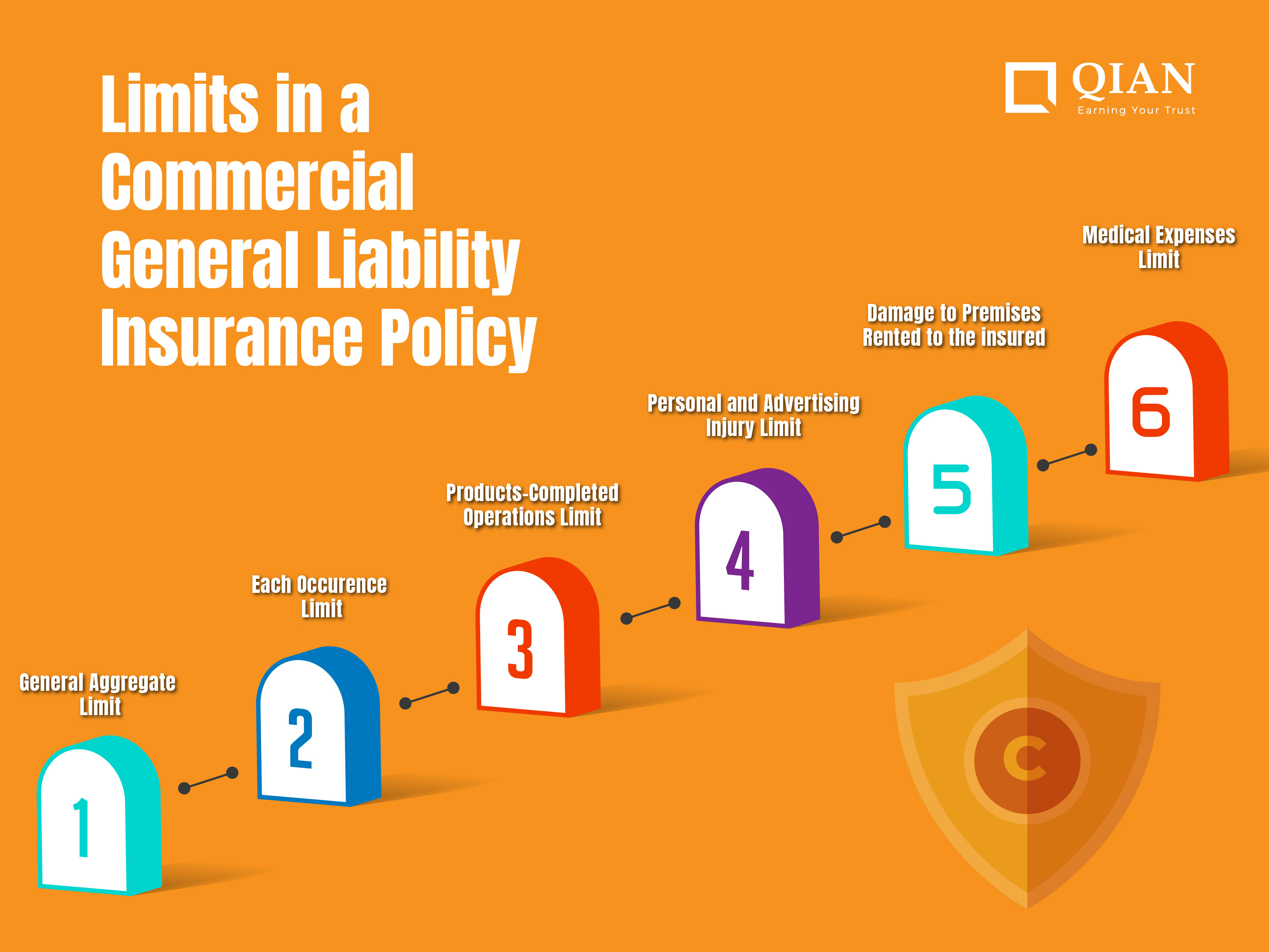
A Commercial General Liability Insurance Policy specifies 6 different limits:
- General Aggregate Limit
- Each Occurrence Limit
- Damages in Premises Rented to You Limit
- Medical Expenses Limit
This article explains the meaning of these various limits and how they impact the Claims. Limits should also be read with the Supplementary Payments under a Commercial General Liability Insurance Policy because court costs, investigation expenses, and interest payments can affect the practical claim outcome.
What is General Aggregate Limit in a Commercial General Liability Insurance Policy? – Definition
General Aggregate Limit is defined as the maximum amount that the Insurance Company will pay for Claims of Bodily Injury or Property Damage, except damages included in the Product-Completed Operations Hazard during the Policy Period. The General Aggregate Limit is The Insurance Company has no further liability after the General Aggregate Limit is exhausted.
There is no restriction on the number of claims that you can make under a CGL Policy. The CGL Insurance Policy will pay claims until the General Aggregate Limit is exhausted. Every time there is a claim under a Commercial General Liability Insurance Policy, the General Aggregate Limit of the CGL Policy gets reduced by the amount of Claim.
The General Aggregate Limit of the Commercial General Liability Insurance Policy applies to the following:
- Coverage A: Bodily Injury and Property Damage (except Products-Completed Operations)
- Coverage B: Personal and Advertising Injury
- Coverage C: Medical Payments
A Separate Limit applies to damage arising out of Bodily Injury or Property Damage caused by Products-Completed Operations
What is an Each Occurrence Limit in a Commercial General Liability Insurance Policy?
An Each Occurrence Limit in a Commercial General Liability Insurance Policy is defined as the maximum amount that the Company will pay for Bodily Injury and Property Damage arising out of any one Occurrence.
Each Occurrence Limit applies separately for each claim, meaning that each Claim Event is subject to its own limit.
What is the Products and Completed Operations Aggregate Limit in a Commercial General Liability Insurance Policy?
An Insured’s Product is a tangible item that the Insured manufactures, sells or distributes to others. Completed Operations is work that the Insured has completed and “put to intended use”.
If there is an event which causes Bodily Injury or Property Damage because of the Insured’s Product or Completed Operations, the Insurance Policy pays for the damages out of the Product and Completed Operations Aggregate Limit.
Note that the damages arising out of Ongoing Operations are paid out of General Aggregate Limit while the damages arising out of Completed Operations are paid out of Products and Completed Operations Aggregate Limit. The difference between Ongoing Operations and Completed Operations is that Ongoing Operations involve work that is still ongoing when the Claim Event occurs while Completed Operations involve work that is finished when the Claim Event occurs.
What is Personal and Advertising Injury Limit in a Commercial General Liability Insurance Policy?
The Coverage B Section of the CGL Policy provides cover for Personal and Advertising Injury. The CGL Policy lists 7 separate offenses which classifies as Personal and Advertising Injury which are listed below:
- False arrest, detention or imprisonment;
- Malicious prosecution;
- The wrongful eviction from, wrongful entry into, or invasion of the right of private occupancy of a room, dwelling or premises that a person occupies, committed by or on behalf of its owner, landlord or lessor;
- Oral or written publication of material that slanders or libels a person or organization or disparages a person’s or organization’s goods, products or services;
- Oral or written publication of material that violates a person’s right of privacy;
- The use of another’s advertising idea in Insured’s advertisement; or
- Infringing upon another’s copyright, trade dress or slogan in Insured’s advertisement.
If the Insured commits any of the above 7 offenses, and becomes legally obligated to pay damages, the CGL Policy provides coverage under the Personal and Advertising Injury section.
The CGL Policy specifies a Limit for Damages arising from Personal and Advertising Injury. Any claim paid under Personal and Advertising Injury Liability also reduces the General Aggregate Limit under the Commercial General Liability Insurance Policy. The CGL Policy pays upto the Personal & Advertising Injury Aggregate Limit for all claims arising because of Personal and Advertising Injury Offenses as mentioned above.
What is Medical Expenses Limit in a Commercial General Liability Insurance Policy?
The Medical Payments Section (Coverage C) of the Commercial General Liability Insurance Policy provides a reduced limit for Medical Payments.
The Policy pays for the Medical Bills of Bodily Injury or Property Damage irrespective of the fault of the Insured Party. It is a No-Fault Liability Cover and pays for small injuries/first aid to the injured Party. The idea is to reduce litigation. The limit applies to each person separately. Payments made for Medical Expenses under Coverage C of the CGL Policy will reduce the General Aggregate Limit.
What is the Damage to Premises Rented to the Insured Limit in a Commercial General Liability Insurance Policy?
A typical Commercial General Liability Insurance Policy provides a reduced limit for Damage to the Premise rented to the Insured. CGL Policy excludes coverage for damage to property owned, rented or occupied by the Insured. It only provides coverage for Third Party Property Damage. However, this exclusion is carved back to a certain extent by providing coverage for Damage to Premises rented to the Insured.
A Claim under the Damage to Premises rented to Insured reduces the General Aggregate Limit of the Commercial General Liability Insurance Policy. Damage to Premises Rented to the Insured Limit is the maximum payable amount for property damage to any premises rented to the Insured under Coverage A: Bodily Injury and Property Damage Section of the Commercial General Liability Insurance Policy.
Get Best Quotes for Commercial General Liability Insurance Policy with Qian!
A CGL Policy Covers Bodily Injury and Property Damage caused to Third Parties and is indispensable for any business. It is essential to understand the various limits of the CGL Insurance Policy in detail to avoid unwanted surprises later on.
There are many endorsements which might restrict your Policy Coverage and leave your business vulnerable. Thus, it is extremely important to go through the Policy Coverages and Exclusions in detail with the assistance of an experienced Insurance Broker.
If you have any queries regarding your CGL Policy, you can email the commercial liability insurance advisors at Qian at insurance@qian.co.in or call us on 022-35134695. We would be glad to assist you.
Recommended articles in CGL Insurance are listed below
- Explained: Personal and Advertising Injury Liability in a CGL Insurance Policy
- How much does a Commercial General Liability Insurance Policy cost?
- What are Supplementary Payments covered under a Commercial General Liability Insurance Policy?
- What are the exclusions under a Commercial General Liability Insurance Policy?
- What is Care, Custody and Control Endorsement in a Commercial General Liability Insurance Policy?
- What is Products-Completed Operations Coverage in CGL Insurance Policy?

Rekha Ramakrishana
Full-time Associate Editorial Director for QIAN, covering financial products and services. She has more than two decades of journalism experience, including 10 years of educating consumers about personal finance.